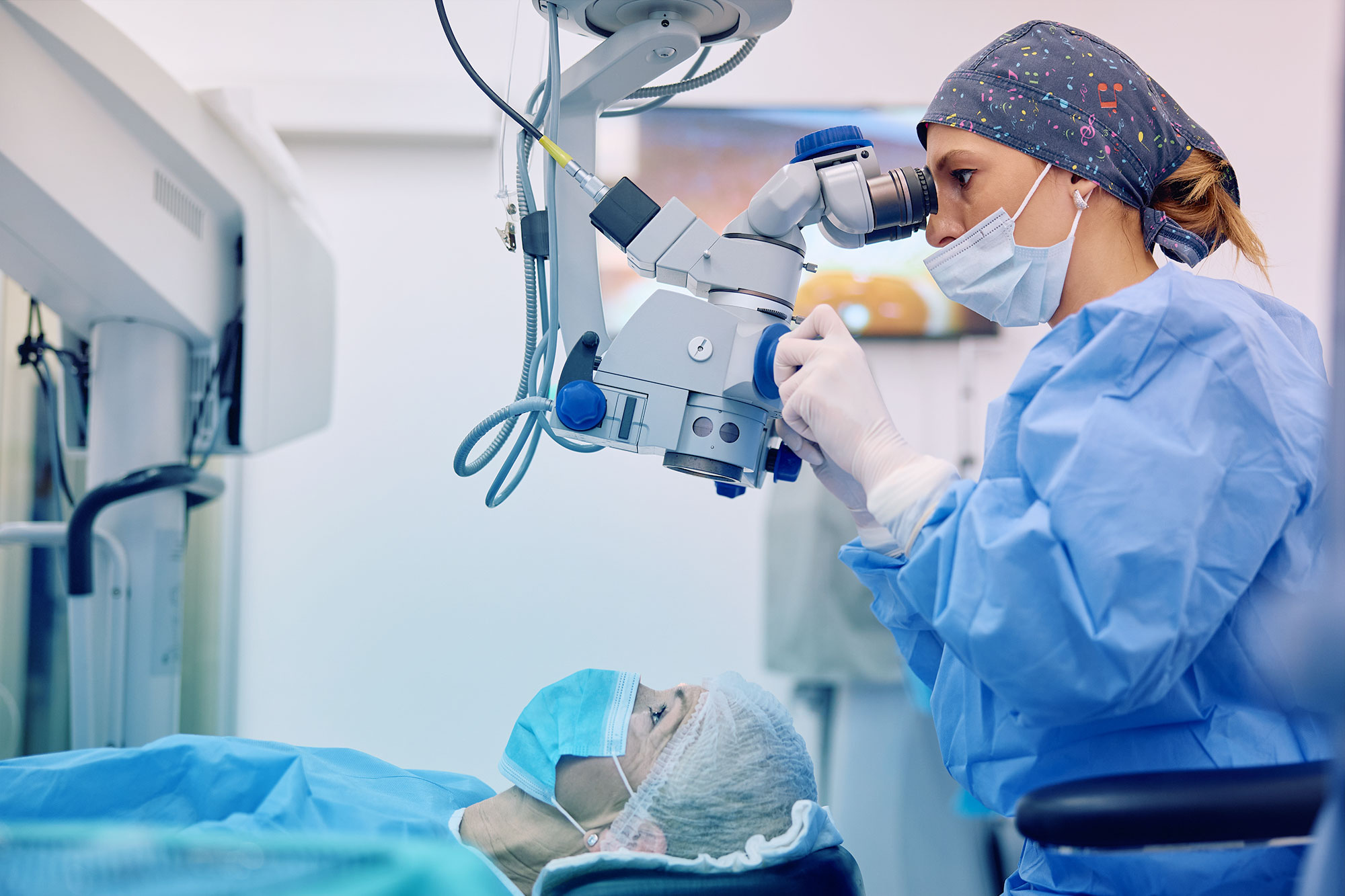
This guide explains why the eye may not focus light correctly, the four main refractive conditions, the symptoms that may appear, and the available correction options. A comprehensive eye examination is important because blurry vision can have more than one cause.
Last Updated: 23/09/2026
Refractive errors are vision problems that occur when light does not focus correctly on the retina, causing blurred or distorted vision. The four main types are myopia, hyperopia, astigmatism, and presbyopia. They can usually be corrected with eyeglasses or contact lenses, while refractive surgery may be an option for suitable patients.
A comprehensive eye examination helps identify the type and degree of the refractive error and determine the most appropriate vision correction option.
If you want to understand how vision correction is assessed and which options may be considered after an eye examination, explore Magrabi Health’s refractive care services.
A refractive error develops when light entering the eye does not focus precisely on the retina. The cornea and lens normally bend, or refract, light so that it reaches the retina clearly. Changes in eye shape, corneal curvature, or lens function can shift that focus and produce blurry vision.
The National Eye Institute explains in Refractive Errors article that focusing problems can result from an eyeball that is too long or too short, differences in corneal shape, or age-related changes in the lens.
The four main types of refractive error affect how the eye focuses light and can influence near vision, distance vision, or both. Each type develops through a different change in the eye’s shape, cornea, or lens, which means the pattern of blurred or distorted vision can vary from one person to another.
Understanding the difference between these refractive eye problems helps explain why eye prescriptions and vision correction needs are not the same for everyone. The main refractive errors of eye differ according to where incoming light focuses in relation to the retina.
Magrabi Health doctors explain that identifying the specific type of refractive problem is important because the appropriate vision correction depends on the individual eye examination and prescription.
Myopia, or nearsightedness, makes distant objects appear blurred while near objects may remain clearer. It often occurs when the eye is too long from front to back or when the cornea or lens bends light too strongly, causing light to focus in front of the retina instead of directly on it. People with myopia may notice difficulty seeing road signs, classroom boards, or other objects at a distance.
Hyperopia, or farsightedness, can make near vision difficult and may also affect distance vision depending on its severity and the person’s age. It can occur when the eye is too short or when the cornea or lens does not bend light strongly enough, causing light to focus behind the retina. Some people may experience eye strain or difficulty maintaining clear focus during reading and other close work.
Astigmatism can cause blurry or distorted vision at both near and far distances. It is usually related to differences in the curvature of the cornea or lens, which cause light to focus unevenly rather than at a single point on the retina. This may make lines, text, or objects appear less sharp and can sometimes contribute to eye strain.
Presbyopia is an age-related loss of near focusing ability that develops as the natural lens becomes less flexible. Reading small text, using a phone, or performing other close tasks may gradually become more difficult, and some people find themselves holding reading material farther away. Presbyopia usually becomes noticeable from middle age and is different from myopia or hyperopia.
The main refractive error causes are related to differences in the shape, length, or focusing structures of the eye. For clear vision, the cornea and lens must bend incoming light so that it focuses precisely on the retina. When the eye is too long or too short, or when the cornea or lens changes shape, the focal point can fall in front of, behind, or unevenly across the retina.
The causes of refractive error vary depending on the specific condition and may include:
An eyeball that is longer or shorter than usual, affecting where light focuses inside the eye.
Differences in the curvature or shape of the cornea, which may cause light to focus unevenly.
Changes in the shape or focusing power of the lens.
Age-related loss of lens flexibility, which is the main factor behind presbyopia.
Family history and inherited tendency, which can increase the likelihood of developing certain refractive eye problems.
Eye growth can also change refractive status over time, particularly during childhood and adolescence. In adults, age-related changes in the lens may gradually affect near focusing ability even when distance vision was previously clear.
In clinical terms, the etiology of refractive error depends on which part of the eye’s focusing system has changed and where incoming light focuses relative to the retina. These differences determine the type and degree of refractive correction needed for clearer vision.
Common refractive error symptoms can include blurred or distorted vision, eye strain, headaches, and difficulty focusing. The pattern of refractive errors symptoms can vary depending on whether the condition affects near vision, distance vision, or both.
Blurred vision at near, far, or both distances.
Distorted vision.
Squinting to see more clearly.
Headaches after reading or visual work.
Eye strain or tired eyes.
Difficulty focusing while reading or using screens.
Glare or halos around bright lights in some cases.
Symptoms may develop gradually. Some people may not notice a change until an eye examination shows that their prescription has shifted.
Magrabi Health doctors emphasize that persistent vision changes should be assessed through an eye examination because similar symptoms can also occur with other eye conditions.
If blurred or distorted vision is affecting your daily activities and you are unsure which eye service you need, you can contact the Magrabi Health team on WhatsApp for guidance on the appropriate consultation or vision correction pathway.
Diagnosis usually begins with a comprehensive eye examination. The ophthalmologist or optometrist first checks visual acuity to measure how clearly the patient can see at different distances, then performs refraction to determine the lens power needed to focus light more accurately on the retina.
Refraction may involve comparing different lens strengths to identify the prescription that provides the clearest vision. The examination can also assess whether the refractive problem mainly affects near vision, distance vision, or both.
The doctor may also examine the cornea, lens, eye surface, and general eye health. Depending on the findings, additional measurements may be used to evaluate corneal shape, eye focusing ability, or other factors that could influence vision correction.
This is important because blurred vision is not always caused by an error of refraction. A comprehensive assessment helps distinguish refractive eye problems from other eye conditions and ensures that treatment is based on the confirmed diagnosis rather than symptoms alone.
People searching for vision correction may have several choices. The appropriate refractive error treatment depends on the type of vision problem, prescription, age, eye health, and personal needs.
Refractive errors treatment is not the same for every patient. The appropriate approach depends on the type and degree of the refractive problem, prescription stability, corneal health, age, lifestyle, and overall eye condition.
Common options include:
Eyeglasses: Corrective lenses adjust how light enters the eye and can correct many prescriptions.
Contact lenses: These provide refractive correction directly on the eye surface and may be suitable for people who prefer an alternative to glasses.
Refractive surgery: Procedures such as LASIK or PRK may reduce dependence on glasses or contact lenses in selected adults after a detailed suitability assessment.
Lens-based options: Some patients may be considered for lens-based vision correction depending on age, prescription, corneal findings, and other clinical factors.
Cleveland Clinic notes that eyeglasses, contact lenses, and vision correction surgery are established treatment options. Surgery is not appropriate for everyone, so a doctor should assess corneal health, prescription stability, eye surface condition, and overall eye health before recommending a procedure.
Magrabi Health doctors explain that choosing between eyeglasses, contact lenses, laser vision correction, or other refractive options should follow a comprehensive eye assessment rather than depend on prescription strength alone.
Many refractive eye problems cannot be fully prevented because they are linked to eye anatomy, inherited factors, natural eye growth, or age-related changes in the lens. However, regular eye care can help detect changes early and ensure that vision correction remains appropriate.
Useful steps include:
Having regular comprehensive eye examinations, especially if vision changes or there is a family history of refractive problems.
Updating eyeglasses or contact lens prescriptions when recommended.
Using prescribed corrective lenses rather than relying on squinting or adjusting viewing distance.
Taking regular breaks during prolonged near work or screen use to reduce eye strain.
Seeking an eye examination if blurred vision, headaches, or difficulty focusing become persistent.
Following the eye doctor’s advice about contact lens use, eye hygiene, and follow-up visits.
Good visual habits can support eye comfort, but they do not prevent every error of refraction or replace corrective lenses when they are needed. If vision changes, the safest approach is to identify the cause through an eye examination rather than continuing to use an old prescription or adapting to persistent blurry vision.
An eye examination is recommended when vision changes become persistent, interfere with daily activities, or are no longer corrected well by your current eyeglasses or contact lenses.
You should consider seeing an eye doctor if you notice:
Persistent blurry or distorted vision.
Difficulty seeing clearly at near or far distances.
Frequent squinting to improve focus.
Eye strain or headaches during reading, work, or screen use.
Difficulty driving, especially when reading road signs or seeing clearly at night.
A noticeable change in your usual eye prescription.
Eyeglasses or contact lenses that no longer provide clear or comfortable vision.
Some symptoms require more urgent assessment. Sudden loss of vision, severe eye pain, new flashes of light, a sudden increase in floaters, or rapid changes in vision should not be assumed to be caused by a refraction error.
These symptoms may have other causes and should be evaluated promptly by an eye care professional.
If blurry or distorted vision continues to affect reading, driving, work, or other daily activities, you can call Magrabi Health through a phone call or the booking form so an eye doctor can evaluate the cause and discuss the appropriate next step.
A refractive error can affect near vision, distance vision, or both, but it can usually be identified through a comprehensive eye examination and managed with appropriate refractive correction. The right option depends on the type of focusing problem, prescription, cornea, lens, age, and overall eye health. If vision changes or current corrective lenses no longer work well, a professional eye assessment can help determine the next step.
Medically reviewed By Magrabi Health Specialized Doctors
Medical Disclaimer: This article is for educational purposes only and does not replace professional medical advice. Always consult a qualified specialist.
National Eye Institute – Refractive Errors
Cleveland Clinic – Refractive Errors: Types, Symptoms & Treatments
Dubai Health Authority – Guidelines Eye Health Program at Private Schools of Dubai