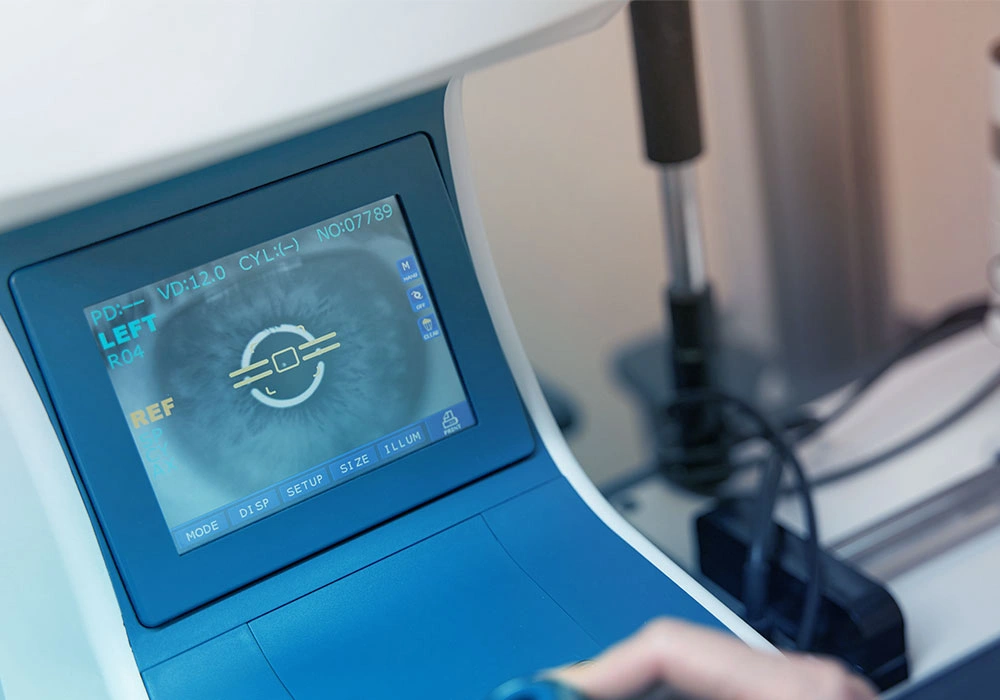
Vision correction after 40 focuses on presbyopia and the changes that affect near vision with age This guide explains glasses lens options and modern treatment approaches to help you choose the most comfortable solution for your lifestyle
Last updated: 16/12/2025
Vision correction after 40 is usually about one thing: presbyopia, the normal shift that makes close-up text look blurry.
In the UAE, you may notice it when reading your phone, menus, or messages—especially after long screen hours. The good news: you have choices.
Reading glasses, progressive lenses, and multifocal contact lenses can help right away. If you want less dependence on glasses, options like monovision LASIK/PRK or lens replacement (RLE) may suit some people after an eye exam for guidance.
If you’re noticing changes in your near vision after 40, book a comprehensive eye examination to understand your options and choose a safe, personalized vision correction plan.

Vision correction after 40 often starts with understanding presbyopia. Presbyopia is a normal age-related change where the eye gradually loses its ability to “auto-focus” up close.
It happens because the natural lens and focusing system become less flexible over time. That’s why small text begins to look blurry, and you may find yourself holding your phone farther away or needing brighter light to read comfortably.
Presbyopia is not a disease—and it doesn’t mean you did something wrong. It’s simply a common milestone of how eyes age, and it can be managed with the right option for your daily routine.
They can feel similar, but they’re not the same problem.
Presbyopia is age-related: after 40, the eye’s focusing ability for near tasks becomes weaker, even if your distance vision is fine.
Hyperopia (farsightedness) is a refractive error linked to the shape of the eye, and it can affect near vision at any age (and sometimes distance too).
Some people have both presbyopia and hyperopia, which is why a proper refraction test is important—so your correction matches what’s actually causing the blur.
Presbyopia itself is age-related, but some people notice the problem earlier because other factors make near vision feel worse.
Long hours spent on screens can increase eye strain, making blur more noticeable by the end of the day.
Reading in dim lighting forces the focusing system to work harder, which may reveal early difficulty with near vision.
In air-conditioned environments, dry eye is common, and dryness can cause fluctuating blur and discomfort—especially for contact lens wearers. Treating dryness and adjusting daily habits may improve clarity, even before changing your prescription.
Presbyopia usually shows up slowly. Most people first notice it during simple daily tasks—reading a message, checking a receipt, or focusing on close-up work—then it becomes more obvious over time.
Common symptoms include:
Blurry near vision (small text looks unclear).
Holding your phone or book farther away to read.
Eye strain after screen work, especially late in the day.
Headaches linked to reading or close-up tasks.
Needing brighter light to read comfortably.
Slower focus changes between the road, dashboard, and phone while driving.
Non-surgical options are often the easiest first step for Vision correction after 40. They’re fast to try, easy to adjust, and can be matched to your daily routine—whether you read a lot, work on screens, or drive frequently in the UAE.
Reading glasses can work very well—but the best type depends on your eyes. Ready-made readers may suit people with similar strength in both eyes and minimal astigmatism.
reading glasses are usually better if one eye needs a different power, if you have astigmatism, or if you want clearer comfort for longer reading.
If the power is wrong, you may feel more strain, not less—so an eye exam helps you choose safely.
If you don’t want to keep switching glasses, progressives or bifocals can combine multiple distances in one lens.
Progressive lenses give a smooth transition from distance to intermediate (computer) to near—many people prefer them for office work and driving.
Bifocals have two clear zones with a visible line: distance on top and near at the bottom. They can be simpler to adapt to for some, but offer less comfort for the “middle” screen distance.
If most of your day is screens, a dedicated “computer” or occupational lens may feel more comfortable than standard progressives.
These lenses focus on intermediate and near distances, which can reduce neck strain and make long hours on a laptop easier.
They’re especially useful if you switch between meetings, emails, and reading documents. In the UAE, pairing this option with dry-eye care (as advised) can make a noticeable difference in comfort.
Surgical options can help some people rely less on glasses, but they are not “one-size-fits-all.” The right choice depends on your eye health (cornea, lens, retina), dry-eye status, and what you do every day—especially screens and night driving. A detailed eye exam is essential before considering any procedure.
Monovision LASIK/PRK corrects one eye mainly for distance and the other mainly for near. This can reduce the need for reading glasses for some people.
However, it may take time for the brain to adapt, and a small number of patients notice trade-offs—such as reduced depth perception or more sensitivity at night. Many clinics test monovision first (for example with contact lenses) to see if you tolerate it before surgery.
Refractive Lens Exchange is a procedure where the natural lens is replaced with an artificial intraocular lens (IOL) to correct vision and address presbyopia.
It’s often discussed for people in their mid-40s and above (case-dependent), especially if they want a longer-term option or are not ideal candidates for corneal laser surgery.
Lens choice matters: some designs prioritize range of vision, while others prioritize night-vision quality and contrast.
If cataract is present (even early), cataract surgery can be an opportunity to plan for both clearer vision and reduced dependence on reading glasses.
Premium IOLs may include EDOF (Extended Depth of Focus) lenses and multifocal lenses.
EDOF lenses often aim for a wider usable range with fewer visual side effects for some people, while multifocal lenses may provide stronger near vision for certain lifestyles—yet can increase halos or glare in some cases. Your surgeon will weigh your eye health and night-driving needs before recommending a lens type.
For more information about presbyopia, vision changes after 40, and the available vision correction options, we recommend visiting our Refractive and Cornea Care service page and speaking with your eye specialist.
A practical way to decide is to match the option to your routine:
If you drive a lot at night: prioritize solutions with stable night vision and fewer halos.
If you spend long hours on screens: consider intermediate vision needs (not only “near”).
If you have dry-eye symptoms: treat dryness first, because it affects comfort and outcomes.
If you want “less glasses,” define what that means: reading only, screens, or full-day independence.
If you’re unsure: ask for a trial strategy (like monovision contacts) before committing.
Recovery depends on the vision correction option you choose, but the fundamentals are consistent: protecting the eyes, following post-procedure instructions, and attending follow-up visits as advised.
Air-conditioned environments, dry air, and everyday exposure to dust can increase dryness and irritation, making careful eye-surface care an important part of recovery.
Your eye doctor will provide a personalized aftercare plan, and many people are pleasantly surprised by how much comfort improves when dryness is managed properly and eye rubbing is avoided.
Vision correction after 40 is not about chasing “perfect” vision—it’s about choosing the most comfortable, practical solution for your daily life in the UAE.
Presbyopia is normal, and options range from simple reading glasses to advanced lens-based procedures.
If you notice ongoing or concerning changes in your vision after 40, schedule a comprehensive eye examination to assess refractive errors and discuss a personalized treatment plan with your eye specialist.
This article provides general educational information about cataract surgery in Ain and is not a substitute for a personal medical consultation, diagnosis, or treatment plan. Individual cases vary. Always discuss your specific condition and treatment options with a qualified ophthalmologist.
Reviewed by Dr. Moataz Sallam, Consultant Cataract, Refractive and Anterior Segment Surgeries, with 20+ years of experience in phaco-refractive and cornea care in Dubai and Al Ain.
American Academy of Ophthalmology (AAO). Presbyopia: What Is It and How Is It Treated?
National Eye Institute (NEI). Facts About Presbyopia.
World Health Organization (WHO). Vision impairment and blindness.
American Optometric Association (AOA). Presbyopia and Aging Eyes.