Hyperopia in children is a refractive error that may cause blurry near vision, eye strain, headaches, or eye crossing. Learn how pediatric hyperopia is diagnosed, when glasses may be needed, and why early assessment supports healthy visual development.
Last Updated:18/10/2026
Hyperopia in children, also called farsightedness, is a refractive error in which light focuses behind the retina instead of directly on it. Mild hyperopia is common in childhood and may cause no noticeable symptoms because children can often compensate by increasing their focusing effort.
Higher levels of hyperopia can cause blurry near vision, eye strain, headaches, or difficulty focusing. In some children, significant hyperopia may also be associated with strabismus or amblyopia. A pediatric eye exam helps determine whether the child needs monitoring, corrective glasses, or further treatment.
If you want to understand how childhood vision, refractive errors, squint, and lazy eye are assessed, explore Magrabi Health’s Pediatric Ophthalmology service and the available pediatric eye care pathways.
Childhood hyperopia, also called farsightedness or hypermetropia, is a refractive error in which light focuses behind the retina instead of directly on it. This can make nearby objects appear blurry, although children with mild hyperopia can often compensate by increasing their natural focusing effort, known as accommodation.
Mild hyperopia is common in young children and may not always require treatment. The need for glasses or monitoring depends on the degree of hyperopia, the child’s vision, symptoms, eye alignment, and stage of visual development.
If you are searching what is hyperopia in the eye, it refers to the same focusing problem in which light does not fall directly on the retina. The search phrase hyperopia farsightedness also describes the same refractive error.
The American Association for Pediatric Ophthalmology and Strabismus explains that hyperopia can occur when the eye is too short or does not focus light strongly enough. It also notes that small amounts of hyperopia are common in young children and may not always require treatment.
For a broader explanation of refractive error, you can also read Magrabi Health’s Refractive Errors: Types, Causes, Symptoms and Treatment.
Childhood hyperopia usually occurs when the eye is too short from front to back or when the cornea and lens do not focus light strongly enough. As a result, incoming light focuses behind the retina instead of directly on it, causing farsightedness.
The main hyperopia causes include:
Eye length: A shorter eyeball can cause light to reach its focal point behind the retina.
Cornea or lens shape: Differences in the curvature or focusing power of the cornea or lens can affect how light is focused.
Family history: Children may be more likely to develop hyperopia when farsightedness runs in the family.
For parents asking what causes hyperopia, the condition is generally related to the natural structure and focusing power of the eye rather than activities such as reading or using screens.
The National Eye Institute explains that farsightedness commonly results from a shorter eyeball or differences in the shape of the cornea or lens. It also notes that many people with farsightedness are born with it and that family history may increase the likelihood of developing the condition.
Hyperopia in babies and toddlers is usually related to normal eye growth and development. Young children often have shorter eyes, which can cause light to focus behind the retina and create some degree of farsightedness.
For parents asking what causes hyperopia in babies, the main factors include:
The naturally shorter length of the eye during early development.
The focusing power and shape of the cornea and lens.
Normal changes that occur as the eye grows.
For those asking what causes hyperopia in toddlers, the cause is generally similar. The eye is still developing, and its length and focusing power may continue to change during early childhood.
Mild hyperopia may decrease as the eye grows. However, higher levels need closer assessment because they can increase focusing effort and may affect eye alignment or normal visual development.
Hyperopia symptoms in children may include blurry near vision, difficulty focusing, eye strain, headaches, frequent eye rubbing, and discomfort during reading or other close activities. Symptoms can vary depending on the child’s age, the degree of hyperopia, and how well the eyes compensate through accommodation.
Possible symptoms and signs include:
Blurry near vision.
Difficulty focusing on books or close objects.
Eye strain after near activities.
Headaches, especially after reading or schoolwork.
Frequent eye rubbing.
Avoidance of prolonged close work.
Squinting or closing one eye.
An eye that turns inward in some children.
Difficulty maintaining comfortable binocular vision.
A child with mild hyperopia may have no obvious symptoms. This is why vision screening and a pediatric eye exam can be important even when the child does not clearly complain about blurry vision.
Hyperopia symptoms in babies can be difficult to recognise because babies cannot describe blurry vision, eye strain, or difficulty focusing.
Mild farsightedness may cause no noticeable signs. With higher levels of hyperopia, concerns may become apparent during an eye examination, vision assessment, or evaluation for persistent eye crossing or abnormal visual behaviour.
Hyperopia symptoms in toddlers may also be subtle because young children may not realise that their vision is different from normal.
Parents may notice:
Frequent eye rubbing.
Difficulty maintaining attention during close activities.
Avoidance of books or other near tasks.
An eye turning inward.
These signs are not specific to hyperopia, so a pediatric eye examination is needed to determine the cause.
Hyperopia child symptoms are often easier to recognise once a child begins reading, writing, and completing longer periods of near work.
Common signs may include:
Headaches after reading or schoolwork.
Tired or strained eyes.
Blurry near vision.
Difficulty focusing on books or close objects.
Avoidance of prolonged near work.
Parents researching hyperopia symptoms in children may notice these patterns during homework or reading. However, these symptoms can have several causes, so an eye examination is needed to confirm whether farsightedness is responsible.
High hyperopia in children means that the child has a stronger degree of farsightedness than is typically expected for their age. This can require the eyes to use more focusing effort to produce clear vision.
Children with high hyperopia may experience:
Blurred vision.
Increased eye strain or focusing effort.
Difficulty maintaining clear vision at near distances.
A higher risk of inward eye crossing in some cases.
An increased risk of amblyopia if normal visual development is affected.
For parents searching for a high hyperopia child, the prescription strength is only one part of the assessment. The National Eye Institute notes that children with severe farsightedness may have a higher risk of crossed eyes and amblyopia.
Treatment decisions also depend on the child’s age, vision in each eye, eye alignment, symptoms, and stage of visual development.
Yes. Significant childhood hyperopia can increase the risk of strabismus and amblyopia, especially when the eyes must use extra focusing effort to maintain clear vision.
When a child uses increased accommodation to focus clearly, the eyes may also turn inward in susceptible children. This type of eye crossing is known as accommodative esotropia.
Amblyopia, or lazy eye, can develop when the brain does not receive a consistently clear image from one or both eyes during visual development. Unequal refractive errors or persistent strabismus can further increase this risk.
Early refractive correction and appropriate follow-up can help support normal visual development when these conditions are present.
If you are unsure whether your child’s symptoms need a pediatric eye assessment, contact Magrabi Health on WhatsApp. The team can help guide you toward the appropriate UAE branch and pediatric eye care pathway.
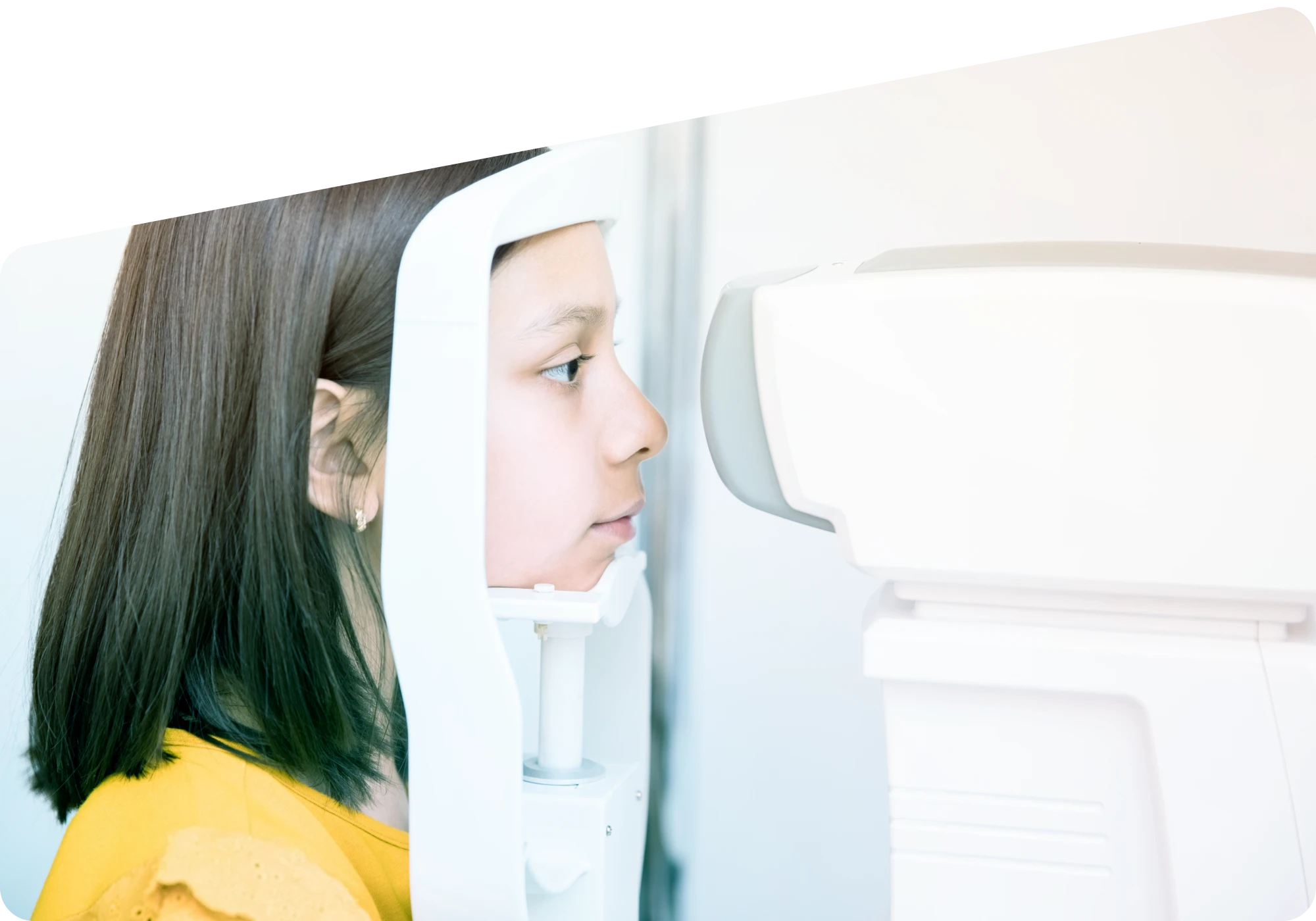
Hyperopia is diagnosed through an eye examination rather than symptoms alone.
A pediatric eye exam may include:
Age-appropriate visual acuity testing.
Assessment of how each eye focuses.
Refraction to measure the glasses prescription.
Eye alignment and movement assessment.
Evaluation of binocular vision.
Examination of the overall health of the eyes.
Young children can compensate strongly for farsightedness through accommodation. For this reason, the pediatric ophthalmologist may use eye drops that temporarily relax focusing during the examination.
This is called cycloplegic refraction. It can help reveal the child’s underlying refractive error more accurately. AAPOS describes dilating eye drops as an important part of measuring refractive error accurately in children.
How to treat childhood hyperopia depends on the child’s age, degree of farsightedness, symptoms, eye alignment, vision in each eye, and visual development. Treatment may include monitoring, hyperopia glasses, contact lenses in selected older children, or additional treatment when amblyopia or strabismus is present.
There is no single hyperopia treatment plan that is suitable for every child.
Mild hyperopia may only need regular monitoring if the child sees clearly, has no significant symptoms, and has normal eye alignment.
The ophthalmologist may recommend follow-up eye examinations to monitor changes in the prescription, vision, and eye development over time.
Hyperopia glasses are the most common treatment when refractive correction is needed.
Prescription lenses with plus power help focus light directly on the retina. The exact prescription depends on the child’s eye examination, symptoms, vision, and eye alignment rather than the refractive number alone.
Children with significant farsightedness, blurry vision, accommodative strabismus, or amblyopia risk may be more likely to need glasses.
Contact lenses may be considered for selected older children or teenagers when clinically appropriate.
Suitability depends on the prescription, eye health, maturity, hygiene, and the child’s ability to insert, remove, and care for the lenses safely.
When hyperopia occurs with amblyopia or accommodative strabismus, correcting the refractive error may be an important part of treatment.
Some children may also need additional amblyopia treatment, such as patching, depending on the ophthalmologist’s assessment. Strabismus treatment depends on the type, cause, and severity of the eye misalignment.
These treatment decisions should be made by a pediatric ophthalmologist based on the child’s complete eye examination.
There is no single permanent hyperopia cure for every child. Glasses can correct how light focuses while they are worn, but they do not permanently change the shape or length of the eye.
Some childhood hyperopia may decrease naturally as the eye grows, while other children continue to need refractive correction.
AAPOS notes that hyperopia can change during childhood and may improve with growth. It also explains that refractive surgery is generally considered only later, after the eyes have stopped growing.
For children, the main goal is to provide clear vision and support healthy visual development rather than to permanently eliminate the prescription.
Yes. Childhood hyperopia can improve with age as the eyes grow and develop, especially when the farsightedness is mild. However, the amount of improvement varies, and it cannot be predicted reliably for every child.
Children with moderate or high hyperopia, reduced vision, eye crossing, or amblyopia still require appropriate follow-up even if their prescription may decrease over time.
A pediatric ophthalmologist can monitor changes in vision, eye alignment, and refractive error and adjust corrective glasses when necessary.
Consider a pediatric ophthalmology assessment if your child:
Has persistent or recurring eye crossing.
Complaints of blurry near vision.
Develops headaches or eye strain during reading.
Frequently rubs or closes one eye.
Has difficulty maintaining focus during close activities.
Has an abnormal vision screening result.
Has noticeably different vision between the two eyes.
Has been diagnosed with amblyopia or strabismus.
Has a strong family history of significant refractive error or childhood eye conditions.
Children may not recognise or report a vision problem themselves. A pediatric ophthalmologist can evaluate refraction, eye alignment, binocular vision, and general eye health before deciding whether correction is needed.
If your child has persistent blurry vision, headaches, eye strain, an abnormal vision screening result, or signs of eye crossing, You can book an appointment with Magrabi Health through a phone call or use the booking form for a complete assessment and personalised treatment plan.
Hyperopia in children is common, and mild farsightedness may not always require treatment. Higher levels can affect focusing, visual comfort, eye alignment, and normal visual development. Because children may not recognise blurry vision themselves, a pediatric eye examination is the most reliable way to determine whether monitoring or corrective glasses are needed. Magrabi Health recommends specialist assessment when symptoms, eye crossing, or vision-screening concerns are present.
Medically reviewed by Magrabi Health Specialized Doctors.
Medical Disclaimer: The information in this article is for health education purposes only and does not replace a visit to a doctor or consultation with a qualified specialist. Magrabi Health doctors recommend seeking medical evaluation for an accurate diagnosis and appropriate treatment plan.
American Association for Pediatric Ophthalmology and Strabismus – Refractive Errors in Children.
National Eye Institute – Farsightedness (Hyperopia).
DHA – Guidelines Eye Health Program at Private Schools of Dubai
Hyperopia in Children: Causes, Symptoms, Diagnosis and Treatment