Last updated: 16/01/2026
Not sure whether your symptoms need a cornea specialist in Abu Dhabi or a routine eye check?
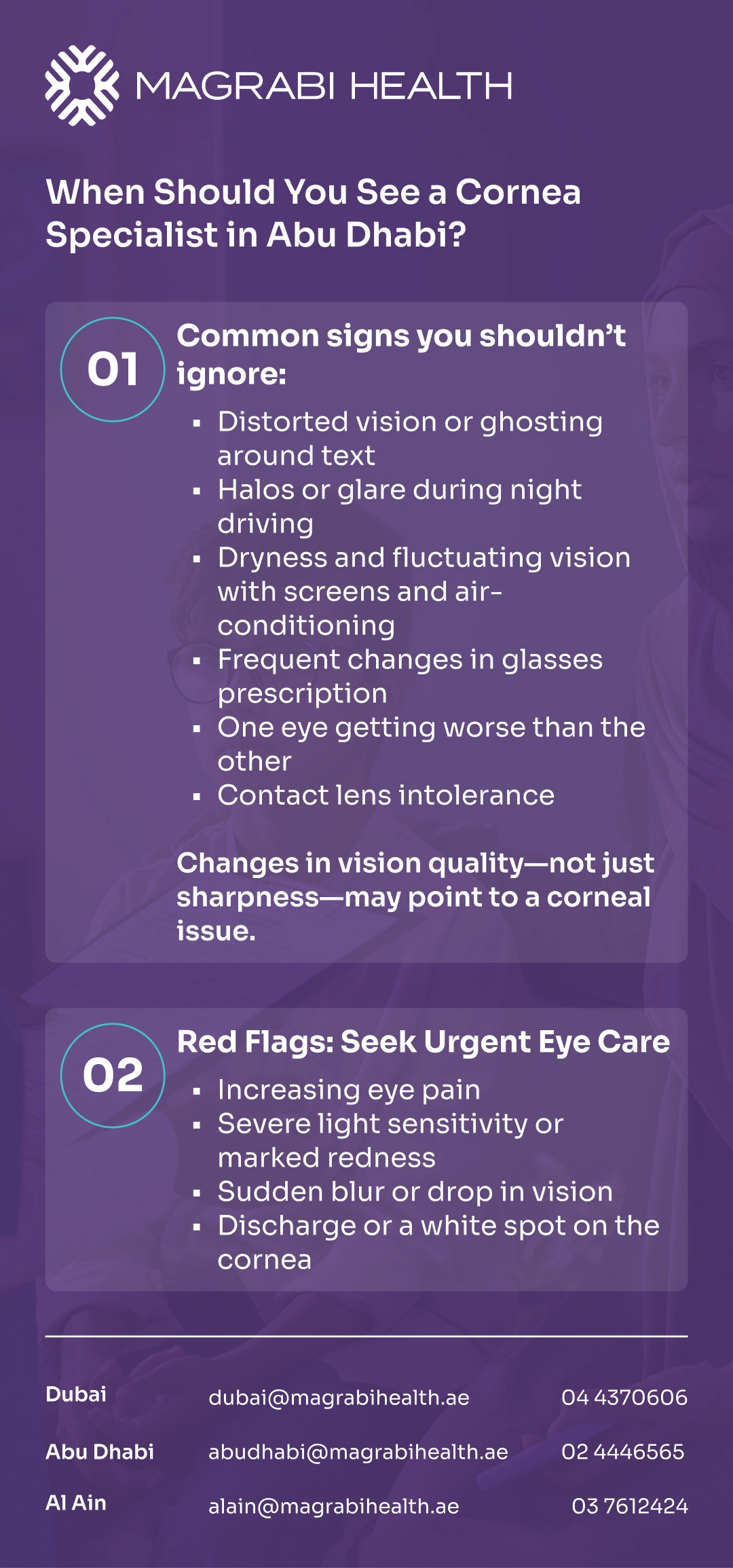
Changes in vision quality—blur, ghosting, halos, glare with night driving—plus dryness from air-conditioning, screen time, or contact lens intolerance can point to corneal or refractive issues.
This patient guide explains when to book a refractive specialist in Abu Dhabi, what a cornea doctor Abu Dhabi assesses (including corneal mapping), and why early review matters for keratoconus treatment in Abu Dhabi and vision-correction decisions.
Ready for a decision based on your corneal maps and lifestyle needs? Book a consultation with an eye specialist at Magrabi Health Hospitals in the UAE.
A cornea and refractive specialist focuses on the cornea (the clear front “window” of the eye) and how its clarity and shape affect vision quality—not just visual acuity on an eye chart.
They also assess the safety and suitability of vision correction procedures based on eye examinations, corneal maps, and the health of the tear film and ocular surface.
In practice, the assessment may include:
A detailed slit-lamp examination of the cornea and ocular surface
Corneal imaging and mapping (topography/tomography) when needed
Evaluation of the tear film, eyelid inflammation, and dryness factors
A personalised plan that may involve medical treatment, specialty lenses, or discussion of appropriate procedures based on the individual case
A routine eye exam is a great starting point for many concerns. But some symptoms and scan findings need deeper corneal analysis, especially when vision quality is affected more than “letter chart” vision.
Consider booking a cornea specialist in Abu Dhabi if you have persistent quality-of-vision complaints (night glare, distortion), frequent prescription changes, contact lens intolerance, or you’re being evaluated for keratoconus, corneal scars, infections, or refractive surgery suitability.
Corneal symptoms can be subtle, especially early on.
Many people search “cornea specialist near me in Abu Dhabi” when they notice fluctuating blur, night glare, or contact lens discomfort that keeps coming back.
These patterns often justify a cornea-focused assessment.
If your vision looks “distorted” rather than simply blurry, the corneal surface or shape may be involved. This is especially relevant if night driving has become difficult.
You may notice:
Ghosting/double edges on text
Halos or glare around lights
Stretching/smearing of headlights at night
A tear film that breaks up quickly can create fluctuating blur and burning or gritty discomfort. Long screen hours, air-conditioned environments, and contact lens wear are common triggers.
If lenses suddenly feel intolerable or your eyes sting more than usual, it’s worth checking the ocular surface and cornea in a structured way.
When one eye changes faster than the other—or your glasses prescription seems to shift repeatedly—your doctor may look for irregular astigmatism or early ectasia patterns that can be missed without corneal mapping.
Some eye symptoms should not wait for a routine appointment. Corneal infections and severe inflammation can worsen quickly, especially in contact lens wearers.
Seek urgent assessment if you have:
Worsening pain in or around the eye (even after removing contact lenses)
Marked light sensitivity, increasing redness, or sudden blurry vision
Watery discharge or unusual discharge
A white/grey spot on the cornea, or difficulty opening the eye due to pain
You can also visit the Refractive and Cornea Care services page on the Magrabi Health Hospitals website to understand what a structured corneal and refractive assessment typically involves.
A cornea specialist doesn’t only treat “rare” problems. Many common complaints—glare, fluctuating blur, lens discomfort—can be cornea-driven.
If you were referred to a corneal disease doctor Abu Dhabi, it often means your symptoms (or prior findings) suggest the cornea’s clarity, surface, or shape may be driving the problem—and corneal imaging can be important.
Keratoconus is a condition where the cornea gradually thins and changes shape, often causing irregular astigmatism and distorted vision.
If you’re looking for an eye clinic for keratoconus in Abu Dhabi, a cornea-led assessment with corneal topography/tomography helps confirm the pattern, track progression, and guide a realistic plan.
Treatment plans may include specialty lenses and, in suitable cases, corneal cross-linking to help slow progression.
Keratitis (corneal inflammation/infection) may happen with contact lens wear or after an injury. Early, correct evaluation matters because delayed treatment can lead to scarring and reduced vision quality.
Corneal Scars after infection or injury, inherited corneal conditions, and corneal swelling can reduce clarity and create glare. Management may involve surface optimisation, lenses, or surgical options depending on depth and severity.
Dry eye and eyelid inflammation can mimic “refractive problems” by causing unstable vision—especially on screens and in air-conditioned settings.
Refractive decisions are safest when based on scans, tear film, and realistic expectations—not just a prescription number.
Before any laser vision correction, specialists typically evaluate corneal shape and stability, corneal thickness, and ocular surface health.
This helps reduce the risk of post-procedure complications and guides procedure selection.
If LASIK is not advised, a refractive specialist may discuss alternatives like PRK for suitable eyes, or other approaches depending on your scans and goals.
Persistent glare, dryness, fluctuating blur, or contact lens intolerance after refractive surgery can sometimes relate to the ocular surface or corneal shape changes and may benefit from cornea-led evaluation.
Knowing what happens during a specialist assessment can lower stress and help you prepare. A cornea/refractive visit is usually structured and data-driven.
Common components include:
History and lifestyle triggers (screens, air-conditioning, night driving, contact lens habits)
Vision testing and refraction.
Slit-lamp examination of the cornea and ocular surface.
Corneal imaging (topography/tomography) and thickness measurement when needed.
Tear-film and eyelid assessment, then a clear plan (treatment, lenses, monitoring, or procedure discussion).
Follow-up depends on your age, symptoms, scan stability, and whether progression is suspected.
Many patients need closer monitoring during periods of change, and less frequent reviews once scans are stable.
If corneal cross-linking is recommended, it’s typically discussed as a treatment intended to stop keratoconus (or ectasia) from getting worse, rather than “returning the cornea to normal.”
“Best” is personal—and in cornea care, good decision-making is usually a better goal than marketing claims.
If you’re searching for the best cornea specialist in Abu Dhabi, focus less on claims and more on whether the clinic offers documented corneal imaging, clear follow-up pathways, and balanced discussion of options and risks.
Focus on whether the clinic can evaluate you thoroughly and follow you safely.
Useful selection checks:
Access to corneal imaging and a clear monitoring pathway.
Experience with keratoconus care (specialty lenses, cross-linking, staged plans when needed).
Balanced explanation of benefits, limits, and risks—no guarantees.
Coordination with a wider eye team if multiple issues overlap.
For an accurate evaluation and an appropriate treatment plan, it is recommended to visit the Abu Dhabi Eye Doctors page, where you can easily book an appointment and receive specialized medical care from experienced physicians.
If you’re dealing with fluctuating blur, night glare, contact lens intolerance, or repeated prescription changes, a cornea-focused assessment can clarify whether the issue is tear film, corneal shape, or a condition like keratoconus.
Early evaluation often means more options and more confidence in your next step.
Want clarity you can trust? Book an eye consultation at Magrabi Health Hospitals in the UAE to review your symptoms, scans, and the safest plan forward.
This article is for general education and does not replace an in-person eye examination. Symptoms can overlap across different eye conditions, and only a clinician can confirm the cause after assessment. If you have severe pain, sudden vision changes, or symptoms of infection, seek urgent medical care.
American Academy of Ophthalmology (AAO) — Corneal Cross-Linking (CXL).
NICE (UK) — Photochemical corneal collagen cross-linkage using riboflavin and UVA for keratoconus.
CDC — Contact lens–related microbial keratitis: symptoms and what to do.
American Academy of Ophthalmology (AAO) — Contact lens–related eye infections.
NHS — Dry eyes: symptoms, triggers (screens/AC), and self-care.
Mayo Clinic — Keratitis: symptoms and why timely assessment matters.
Reviewed by Dr. Moataz Sallam, Consultant Cataract, Refractive and Anterior Segment Surgeries, with 20+ years of experience in phaco-refractive and cornea care in Dubai and Al Ain.