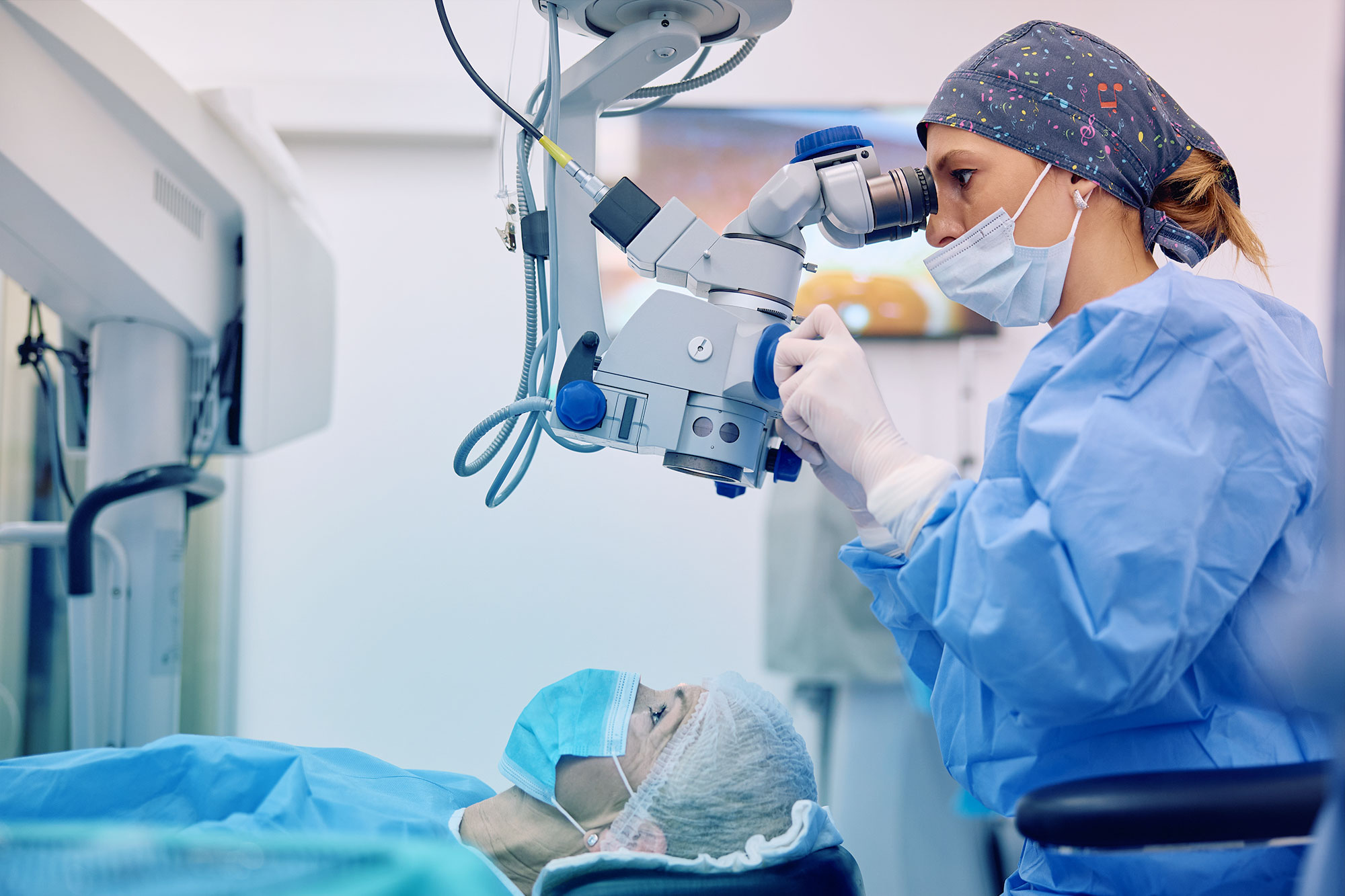
LASIK for astigmatism reshapes the cornea to improve how light focuses on the retina. Learn how candidacy is assessed, what tests are required, and which alternative vision correction options may be considered.
Last updated: 16/07/2026
Astigmatism can make objects appear blurred or distorted at different distances. It occurs when the cornea or natural lens has an uneven curvature, preventing light from focusing properly on the retina.
LASIK for astigmatism can improve vision in suitable patients by reshaping the cornea so that light focuses more accurately on the retina. However, not everyone is a suitable candidate. Corneal thickness, overall eye health, prescription stability, and tear quality should be evaluated through a comprehensive eye examination before treatment.
To understand the available examination and treatment pathways, visit Magrabi Health’s LASIK surgery service.
Yes, LASIK for astigmatism can correct many cases of regular astigmatism by using a precise laser to reshape the cornea. This helps light enter the eye more evenly and focus more accurately on the retina, which can improve vision clarity and reduce dependence on glasses or contact lenses for daily activities such as reading, driving, or using digital devices.
However, LASIK is not suitable for everyone. Patients with irregular corneal shapes, keratoconus, thin corneas, unstable prescriptions, or significant dry eye symptoms may not be ideal candidates. In these cases, alternative vision correction options may be considered. A comprehensive eye examination, including corneal mapping and tear film assessment, is essential to determine whether the procedure is a safe and appropriate choice for each individual.
Astigmatism is a refractive error caused by an uneven curvature of the cornea or lens. Instead of focusing light at a single point, the eye creates multiple focal points, leading to blurred or distorted vision.
Eye prescriptions for astigmatism include:
Cylinder: Degree of astigmatism
Axis: Direction of correction
Sphere: Associated near- or far-sightedness
A toric contact lens may correct astigmatism, but suitability for laser vision correction depends on the corneal structure and overall eye health.
Astigmatism is often related to the natural shape of the eye and may be present from childhood. Common causes include:
Uneven corneal shape
Changes in the natural lens
Family history
Corneal injury or scarring
Previous eye surgery
Keratoconus
Other corneal conditions
Daily habits like reading or screen use do not cause astigmatism but may increase eye strain.
Symptoms vary depending on severity and may include:
Blurred or distorted vision
Difficulty seeing fine details
Eye strain
Headaches
Night vision problems
Glare around lights
Frequent prescription changes
These symptoms require evaluation to determine if LASIK for astigmatism or another treatment is appropriate.
Determining whether a patient is suitable for LASIK for astigmatism requires more than checking the strength of an eyeglass prescription. The ophthalmologist must evaluate the shape, thickness, and overall health of the cornea, as well as the stability of the refractive error and the condition of the eye’s surface.
Magrabi Health doctors emphasize that this detailed candidacy screening helps identify patients who may benefit from LASIK and those who may be better suited to another vision correction option. In addition to patient suitability, the qualifications and experience of the treating ophthalmologist are also important when considering laser vision correction.
According to the Dubai Health Authority (DHA) circular on the practice of refractive vision surgery by LASIK, laser refractive surgery falls within the scope of ophthalmology practice, and the medical director of the healthcare facility is responsible for ensuring that the ophthalmologist has the appropriate certificates, training, and experience to perform the procedure. This reinforces the importance of receiving treatment in an appropriately regulated healthcare setting with a qualified ophthalmologist.
The examination begins with a detailed assessment of the patient’s eye prescription, including short-sightedness, long-sightedness, and the degree and direction of astigmatism. These measurements help the doctor determine the amount and pattern of corneal reshaping that may be needed.
The prescription should generally be stable before laser vision correction is considered. If it continues to change, the visual outcome may be less predictable, and the doctor may recommend postponing treatment until the prescription has stabilized.
Corneal mapping creates a detailed image of the shape and curvature of the cornea. It shows whether the astigmatism follows a regular pattern that may respond well to laser correction or whether the cornea has irregular areas requiring further investigation.
This test can also help detect early signs of keratoconus or other corneal conditions that may make LASIK unsuitable. Accurate corneal mapping is therefore an essential part of planning safe and personalised laser vision correction.
The ophthalmologist measures corneal thickness using a test called pachymetry. Because LASIK reshapes the cornea by removing a carefully calculated amount of tissue, the doctor must confirm that enough healthy corneal tissue will remain after treatment.
A thin cornea does not automatically mean that vision correction is impossible. However, the doctor may recommend PRK, an implantable lens, or another option when standard LASIK would remove more tissue than considered appropriate.
A healthy tear film supports clear vision, accurate preoperative measurements, and comfortable healing. The doctor may examine tear production, tear stability, and the surface of the eye to identify signs of dryness or irritation.
Existing dry eye may temporarily affect corneal measurements and can become more noticeable after LASIK. For this reason, dry eye may need to be managed before the patient is reassessed for surgery.
A comprehensive examination evaluates more than the cornea. The ophthalmologist may assess the pupils, eye pressure, natural lens, retina, and optic nerve to rule out other conditions that could be contributing to blurred vision.
For example, changes in the natural lens or retina will not be corrected by reshaping the cornea. Identifying these conditions helps ensure that the recommended treatment addresses the actual cause of the patient’s visual symptoms.
The doctor will ask about medical conditions, medications, previous eye procedures, pregnancy, contact lens use, and any history of eye injury or disease. Some health conditions or medications may affect healing or influence whether elective laser surgery should be delayed.
Lifestyle and visual needs are also important. Night driving, screen use, sports, work requirements, and expectations about using glasses after surgery can all influence whether LASIK for astigmatism is the most appropriate option.
Before recommending treatment, the ophthalmologist will discuss what LASIK may realistically achieve. The aim is usually to reduce dependence on glasses or contact lenses, but some patients may still need corrective lenses for specific activities or as their eyes change with age.
The doctor may also compare LASIK with alternatives such as PRK, SMILE, or implantable lenses. The final recommendation should be based on the examination findings, the patient’s visual needs, and a balanced discussion of potential benefits and limitations.
Assessment finding | Why it matters when considering LASIK |
Stable eye prescription | Helps ensure that the planned correction reflects the patient’s current and consistent visual needs |
Regular corneal shape | Supports accurate laser planning and helps the doctor exclude irregular corneal conditions |
Adequate corneal thickness | Confirms that sufficient healthy tissue is likely to remain after corneal reshaping |
Healthy tear film | Improves measurement accuracy and may support greater comfort during recovery |
Healthy retina and natural lens | Helps rule out other eye conditions that LASIK would not correct |
Suitable medical history | Reduces concerns related to healing, medication effects, or other health factors |
Realistic expectations | Helps the patient understand the likely benefits, limitations, and possible need for glasses in the future |
Do you have a question about LASIK with astigmatism? Contact Magrabi team through WhatsApp to ask about the assessment and the most appropriate department for your needs.
LASIK eye surgery for astigmatism works by reshaping the cornea so that light can focus more accurately on the retina, helping improve vision clarity.
During the procedure, the surgeon creates a thin flap in the cornea using either a microkeratome blade or a femtosecond laser. The flap is then gently lifted to expose the underlying corneal tissue.
Next, an excimer laser reshapes the cornea by removing microscopic amounts of tissue in a carefully calculated pattern. This helps correct the uneven corneal curvature that causes astigmatism and allows light to focus more accurately on the retina.
The treatment is planned using detailed measurements taken before surgery, including the patient’s prescription and corneal shape. The laser treatment itself usually takes only a few minutes per eye. Once the reshaping is complete, the flap is placed back into position, where it naturally adheres without stitches.
In selected cases, advanced techniques such as custom LASIK or wavefront-guided LASIK may be considered. These methods use detailed corneal mapping and wavefront analysis to address more complex visual imperfections. The most suitable technique depends on factors such as corneal thickness, the type and degree of astigmatism, and overall eye health.
Treatment options for astigmatism vary depending on the severity of the condition, the patient’s age, lifestyle, and personal preferences. The goal of treatment is to improve visual clarity by correcting the irregular curvature of the cornea or lens, allowing light to focus properly on the retina.
Eyeglasses are often the simplest and most common way to correct astigmatism. Special cylindrical lenses are prescribed to compensate for the uneven curvature of the eye, helping to provide clearer and more comfortable vision. Glasses are non-invasive, easy to use, and suitable for patients of all ages.
Toric contact lenses are specifically designed to correct astigmatism by aligning with the unique shape of the eye. They provide more precise correction than standard contact lenses and can offer a wider field of vision compared to glasses. Proper fitting and regular follow-up are important to ensure comfort and effectiveness.
LASIK is a widely used laser vision correction procedure that reshapes the cornea to help light focus more accurately on the retina. The procedure can reduce refractive error and lessen dependence on glasses or contact lenses. It is generally considered for patients with a stable prescription, adequate corneal thickness, and otherwise healthy eyes.
Photorefractive keratectomy (PRK) is another laser-based procedure that corrects astigmatism without creating a corneal flap. Instead, the outer layer of the cornea is gently removed before reshaping the underlying tissue. PRK may be recommended for patients with thinner corneas or those who are not ideal candidates for LASIK.
SMILE (Small Incision Lenticule Extraction) is a minimally invasive laser procedure that corrects certain types of refractive errors, including astigmatism in selected cases. It involves creating and removing a small piece of corneal tissue through a tiny incision, which may result in faster recovery and reduced dryness for some patients.
Implantable lenses, also known as phakic intraocular lenses, are placed inside the eye without removing the natural lens. They are often considered when LASIK for astigmatism is not suitable, particularly in cases of high refractive error or thin corneas. This option can provide excellent visual outcomes while preserving the natural structure of the eye.
Toric intraocular lenses are used during cataract surgery to correct both cataracts and astigmatism at the same time. These lenses are specially designed to address the uneven curvature of the cornea, helping patients achieve clearer vision after surgery and reducing the need for glasses.
While laser eye surgery for astigmatism is generally considered safe, potential side effects include:
Dry eyes
Glare or halos
Night vision issues
Residual refractive error
Need for glasses in some cases
Rare complications affecting the cornea
Patients should discuss risks and expectations before undergoing LASIK for astigmatism.
Astigmatism cannot usually be prevented, but eye health can be supported by:
Regular eye exams
Avoiding eye rubbing
Managing allergies
Proper contact lens care
Using protective eyewear
These steps help detect changes early, especially before considering LASIK for astigmatism.
Consult an eye specialist if vision problems persist or worsen, as early evaluation can help identify the underlying cause and determine the most appropriate treatment. A professional eye examination is also important before considering laser vision correction to confirm that the eyes are healthy and suitable for the procedure. You should consider booking an appointment if you experience any of the following:
Changing prescriptions
Distorted or blurred vision
Persistent dry eye symptoms or discomfort
Family history of corneal disease
Difficulty adapting to glasses or contact lenses
A clear decision begins with accurate measurements. To arrange a vision correction assessment at Magrabi Health UAE, you can contact us through a phone call or the booking form
LASIK for astigmatism can significantly improve vision in suitable candidates by correcting corneal irregularities and reducing dependence on glasses or contact lenses. However, a comprehensive eye examination is essential to determine whether the procedure is appropriate for each patient. Magrabi Health doctors recommend discussing the available treatment options, along with their potential benefits and limitations, before making a decision.
Medically reviewed By Magrabi Health Specialized Doctors
Medical Disclaimer: The information in this article is for health education purposes only and does not replace a visit to a doctor or consultation with a qualified specialist. Magrabi Health doctors recommend seeking medical evaluation for an accurate diagnosis and appropriate treatment plan.
American Academy of Ophthalmology: LASIK—Laser Eye Surgery.
Cleveland Clinic Abu Dhabi: Laser Vision Correction.
Moorfields Eye Hospitals UAE: Astigmatism.
Dubai Health Authority – LASIK Circular No. 90: Practice of Refractive Vision Surgery by LASIK by Ophthalmologists.