Last Update: 1/12/2025
If you are starting to notice cloudy vision, glare from Dubai’s night lights, or difficulty reading road signs and phone screens, cataracts can feel worrying. Many people delay cataract surgery because of fear, age-related concerns, or confusion about “when is the right time.”
Cataract surgery is actually one of the safest and most commonly performed surgeries worldwide when done by experienced surgeons using modern technology.
Dubai, under DHA regulation, has become a regional hub for advanced eye care, but not every center offers the same level of safety, technology, or expertise.
This guide walks you through seven key truths about cataract surgery in Dubai so you can decide calmly, with clear information rather than pressure or guesswork.
Find out if you’re ready for cataract surgery — book your cataract evaluation at Magrabi Hospitals Dubai and discuss your options with a cataract specialist.
Cataracts don’t reverse on their own
A cataract is a gradual clouding of your natural lens. Eye drops, supplements, or “natural cures” cannot clear a true cataract. Once it starts to affect vision, the only definitive treatment is lens removal and replacement with an artificial intraocular lens (IOL).
Cataracts symptoms typically worsen slowly over years. Vision may seem acceptable at first, then more difficult in:
Night driving (halos and glare from headlights)
Reading, especially in low light
Recognizing faces or road signs
Moving safely on stairs or uneven pavements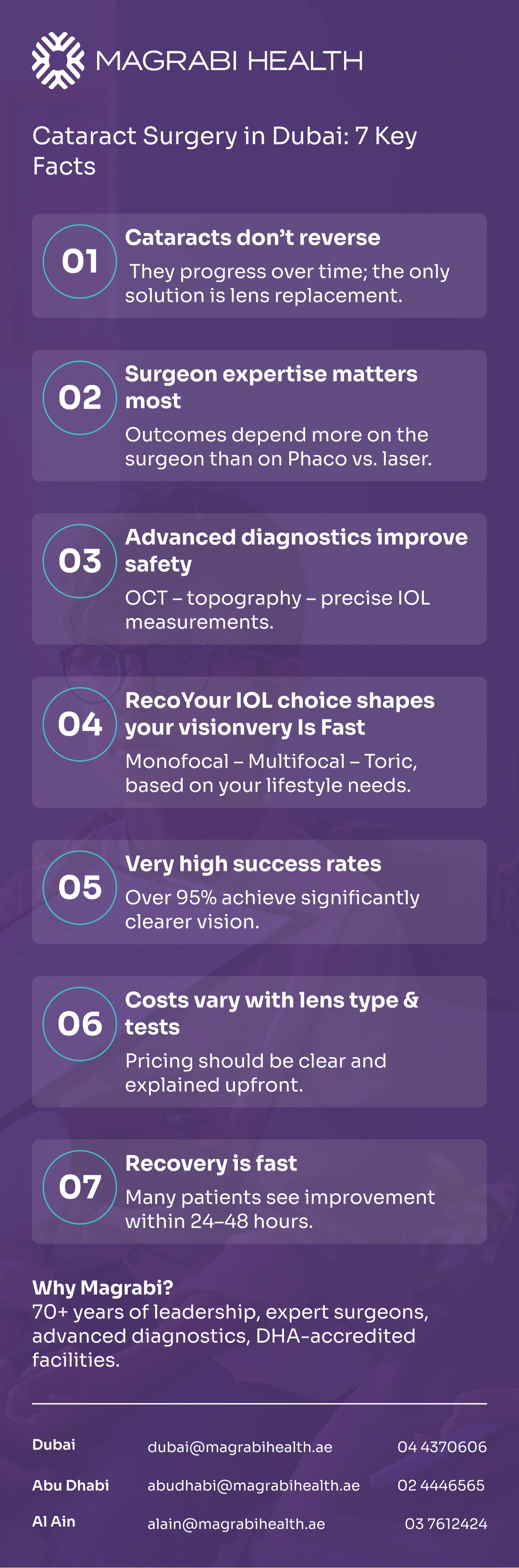
Globally, cataract surgery is recommended when reduced vision starts to interfere with normal activities:
Driving safely, especially at night
Work tasks that require clear focus
Independence at home (cooking, reading medication labels)
In the UAE, driving standards generally require a visual acuity of around 6/12 or better in at least one eye, with adequate peripheral vision, to drive safely and legally.
If cataracts reduce you below this level, surgery becomes not only a quality-of-life decision, but also a safety issue.
Modern cataract surgery is very safe, but extremely advanced (“mature” or “hyper-mature”) cataracts can be harder to remove and may carry a slightly higher risk of complications.
That does not mean you must rush into surgery. It does mean you should not ignore progressive symptoms for years without proper evaluation.
If cataracts are suspected, schedule a comprehensive eye exam and ask your doctor directly: “Is it safe to wait, or is this the right time for surgery?”
If you’re also wondering about the ideal timing for surgery, you may find this guide useful: Understanding Cataract Age and Timing: When to Get Surgery.
Techniques matter, but the surgeon matters more
In Dubai, you will hear terms like phacoemulsification (Phaco) and laser-assisted cataract surgery (Femto-cataract). Both are modern, widely accepted methods.
While technology supports precision, the surgeon’s experience remains the most important factor in your outcome.
An experienced cataract surgeon will:
Perform a high volume of cataract surgeries every year
Be comfortable managing dense or complex cataracts
Follow evidence-based safety protocols
Take time to explain benefits, risks, and realistic expectations
When comparing cataract surgery in Dubai, focus on:
Credentials and training in cataract and lens surgery
DHA licensing and subspecialty registration
Participation in audit, quality, or outcome programs
Clear communication and willingness to answer your questions
At Magrabi Hospitals Dubai, cataract procedures are performed by ophthalmologists who focus on cataract and lens surgery, and work within standardized clinical pathways to support consistent, safe outcomes.
Need help evaluating your options?
A consultation with Dr. Mohammed Hashim Ali at Magrabi Hospitals can give you clear, accurate answers about your condition—saving you weeks of uncertainty and online searching.
Modern diagnostics are the foundation of safe cataract surgery
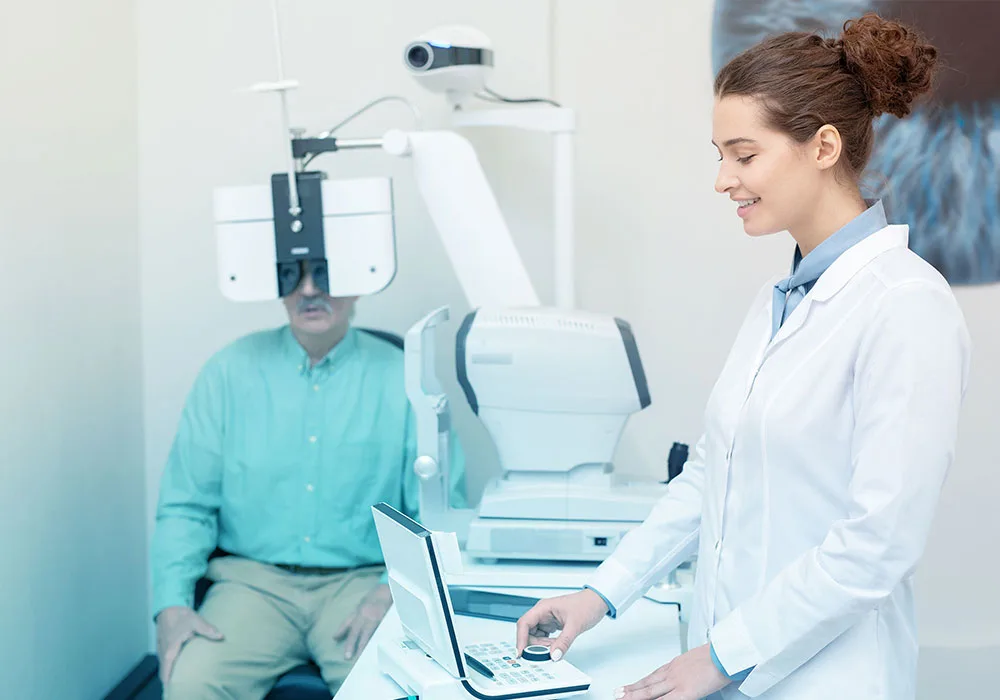
Before cataract surgery in Dubai, a high-quality center will perform detailed tests such as:
Optical coherence tomography (OCT) to assess the retina and macula
Biometry (e.g., IOL Master) to calculate the power of your intraocular lens
Corneal topography to map the shape of the cornea and detect irregularities
These measurements help reduce surprises after surgery and improve the chance of sharp, stable vision.
Some Dubai centers offer laser-assisted cataract surgery is one of Cataract Treatment Options. In this method, a femtosecond laser helps with steps such as:
Creating corneal incisions
Opening the lens capsule
Pre-fragmenting the cataract
Laser assistance can improve precision in selected cases, especially for premium lens implantation, but it is not mandatory for a safe outcome. For many patients, standard Phaco performed by an experienced surgeon is entirely appropriate.
You can learn more about these technologies in detail on your eye hospital’s “Technology Used in Top Eye Hospitals in Dubai” page.
True safety also depends on:
Regular calibration of machines
Strict sterilization protocols for instruments
Operating room air quality and infection control
Trained nursing and anesthesia staff
Magrabi Hospitals Dubai uses standardized sterilization, tracking, and quality-assurance protocols designed to reduce infection risk and improve operating room consistency.
Different IOL types serve different lifestyles
During cataract surgery, your cloudy natural lens is replaced by an artificial intraocular lens (IOL). The main categories are:
Monofocal IOL
Clear vision at one main distance (usually far)
Often still need glasses for reading or computer work
Multifocal / Trifocal IOL
Designed to provide vision at near, intermediate, and far
Can reduce dependency on glasses
Higher chance of halos or glare around lights at night for some patients
Toric IOL
Corrects astigmatism (irregular corneal shape)
Can be monofocal or multifocal
The “best lens” is not the same for everyone. Your surgeon should ask about:
Your daily tasks (driving at night, office work, reading)
Your hobbies (golf, sewing, screen time)
Your tolerance for possible halos or glare
Whether you are comfortable continuing to use glasses for certain tasks
The IOL discussion should feel like a shared decision, not a sales pitch.
For more detailed breakdowns, many eye hospitals provide dedicated articles on cataract lens types and how to choose them.
Tip: Write down your top 3 priorities (for example: “sharp night driving,” “comfortable reading,” “less dependence on glasses”) and bring this list to your pre-surgical counseling.
Discover the key differences between traditional cataract surgery and laser-assisted cataract surgery, and learn how modern, bladeless techniques can offer greater precision and safer outcomes. For the full breakdown, visit the page: The Difference Between Traditional Cataract Surgery and Laser Cataract Surgery.
Cataract surgery is one of the safest surgeries worldwide
Large international studies show that cataract surgery has a very high success rate, with over 90–95% of patients achieving significantly improved vision and serious complications occurring in well under 1–2% of cases in modern settings.
Dubai follows DHA regulations and international standards for surgical safety, anaesthesia, and infection control, which contributes to strong outcomes across leading centers.
Many patients experience short-term symptoms such as:
Blurred or fluctuating vision in the first few days
Mild irritation or dryness
Light sensitivity or halos, especially at night
Slight redness
These usually improve as the eye heals and the tear film stabilizes.
Less common but more serious issues (such as significant infection, retinal swelling, or marked vision drop) are rare, yet they require:
Early recognition
Fast intervention
Close follow-up
This is another reason to choose a facility with experienced cataract surgeons, on-call coverage, and clear postoperative instructions.
Here’s the refined English version:
Most people return to their normal daily activities quickly after cataract surgery. For more information or to request a consultation, you can visit the Cataract Care in the United Arab Emirates page.
What really influences the price?
There is no single fixed price for cataract surgery in Dubai. Total cost depends on several factors:
Type of IOL
Standard monofocal lenses
Premium multifocal, trifocal, or toric lenses
Surgeon’s seniority and expertise
Hospital or day-surgery center level
Operating room standards
Anesthesia and nursing support
Sterilization and diagnostic technology
Pre-operative tests
Advanced scans like OCT, topography, and high-precision biometry
Premium lenses and advanced diagnostics can increase the upfront cost, but they may reduce your long-term need for glasses or future procedures.
Many patients also compare this with refractive procedures such as LASIK. If you’re exploring vision correction costs in the UAE, you can also review the factors that determine pricing on the page: Cataract Surgery Cost in the UAE.
Some insurance plans in the UAE cover part of cataract surgery when it is medically necessary. Coverage often depends on:
Your policy type
The presence of documented cataracts
The type of lens chosen
Magrabi Hospitals & Centers work with many major insurance providers; patients are encouraged to confirm coverage in advance.
Book an appointment at Magrabi Hospitals Dubai to receive a personalized cataract surgery plan and cost estimate based on your eye measurements, lifestyle, and lens options.
Typical recovery timeline: while everyone heals differently, many patients notice…
Clearer vision within 24–48 hours
Continued sharpening over the first 1–2 weeks
Full stabilization over several weeks
Most people go home the same day as surgery and can resume light activities quickly, following their doctor’s advice.
To protect your eye in the first days to weeks, you will usually be asked to:
Avoid rubbing or pressing on the eye
Use prescribed eye drops exactly as instructed
Avoid swimming pools, hot tubs, and dusty environments for a period
Be careful with heavy lifting or intense exercise until cleared
Your doctor will schedule follow-up visits (often the next day, then after 1–2 weeks) to check healing and adjust drops.
Cataract surgery is also a chance to review:
Other eye conditions (glaucoma, macular disease, diabetic retinopathy)
Long-term protection from UV and blue light
Lifestyle choices that support eye health
Cataract surgery is not only about removing a cloudy lens. It is about restoring safe, comfortable vision for daily life in a fast-moving city like Dubai.
Many patients choose Magrabi Hospitals Dubai for cataract surgery because of:
Over 70 years of regional leadership in ophthalmology
Highly experienced cataract surgeons, many with international training
Premium diagnostic platforms for accurate IOL calculation and retinal assessment
Safe anesthesia protocols tailored to your health status
DHA-accredited facilities with strict sterilization and infection-control standards
You can review quality recognitions and accreditations on the Magrabi Accreditations page for additional reassurance.
At Magrabi, cataract patients are evaluated in a structured way: full eye exam, measurements, discussion of lens choices, and a clear plan that matches your expectations with what is medically realistic.
Don’t Rush, But Don’t Stay in the Dark
Cataract surgery in Dubai combines high safety, modern technology, and customized lens options, especially in DHA-accredited centers with experienced surgeons.
The key truths to remember are:
Cataracts don’t reverse and can eventually limit safe driving and independence.
Surgeon expertise and proper diagnostics matter more than “marketing trends.”
IOL choice shapes your vision after surgery as much as the procedure itself.
Costs vary based on lens type, technology, and hospital level—but should always be transparent and explained before you decide.
If you feel your world is slowly getting dimmer, you don’t need to decide today—but you also don’t need to live with constant glare and blur without answers.
Ready to take the next step?
Schedule your cataract assessment at Magrabi Hospitals Dubai and receive expert guidance tailored to your eyes, your lifestyle, and your long-term vision needs.
This article provides general educational information about cataract surgery in Dubai and is not a substitute for a personal medical consultation, diagnosis, or treatment plan. Individual cases vary. Always discuss your specific condition and treatment options with a qualified ophthalmologist.
This content was written and reviewed by the ophthalmology editorial team at Magrabi Hospitals & Centers to reflect current medical knowledge and regional practice standards.
Dubai Health Authority (DHA) – Cataract care guidelines and surgical safety standards.
Department of Health Abu Dhabi (DOH) – Clinical practice standards for ophthalmology and visual acuity requirements.
UAE Ministry of Health & Prevention (MOHAP) – National policies for patient safety, infection control, and day-surgery regulations.

Cataract Surgery: Procedure, Benefits, and Recovery Tips

Understanding Cataract Age and Timing: When to Get Surgery

Cataract Causes and Risk Factors Explained by Eye Specialists